
Oehler Research · Sensors and Screens
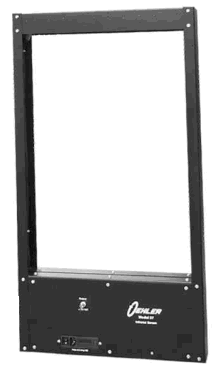
Oehler Model 57
An active ballistic screen with its own infrared source: the standard sensor for indoor ranges, night work and low-light conditions.
The Model 57 is the complement to the sky-lit Skyscreen III. It carries its own infrared source, so it keeps working in an enclosed indoor range, at night, or under poor lighting, which makes it the standard sensor in ballistics laboratories. An infrared source runs along the top and several photodetectors sit in the base; when a projectile crosses the reference plane the screen outputs a nominal +12V pulse about 2 ms wide with a rise time of about 0.1 microsecond, so timing error is very small. It normally detects projectiles as small as .17 caliber at velocities as low as 250 fps, with sensitivity improving for larger projectiles and higher velocities. The System 83, Model 35BNC and Model 35x2 all use the Model 57 as their standard input. A low-velocity variant is available for larger, slower sporting balls and coefficient of restitution testing.
Overview
The point of the Model 57 is to put the light source inside the instrument so the measurement no longer depends on room lighting. The infrared source at the top shines down, the photodetectors in the base receive continuously, and a projectile crossing the reference plane breaks the beam and fires the output. That output is a nominal +12V pulse about 2 ms wide on a BNC connector, with a rise time of about 0.1 microsecond. Rise time decides how precisely the trigger instant is defined, and it is what qualifies the screen for laboratory work. Detection normally covers .17 caliber and up at velocities as low as 250 fps, with better sensitivity for larger projectiles and higher velocities, and automatic gain control compensates for dust in the light path. One practical rule for setup: for velocities below 1,200 fps, and for automatic fire, place a wooden blast shield between the muzzle and the first screen so muzzle flash is not read as a projectile. Units ship set for 120V AC at 50 or 60 Hz and can be changed to 240V operation, so they suit different national grids. The low-velocity variant handles larger, slower sporting balls and COR rebound testing.

Key specifications
| Principle | Infrared source at the top, several photodetectors in the base; detects the projectile crossing the reference plane |
|---|---|
| Caliber | Generally .17 caliber and up; sensitivity improves with larger projectiles |
| Velocity floor | Normally down to 250 fps (sensitivity improves with larger projectiles and higher velocities) |
| Low-velocity and automatic-fire note | Below 1,200 fps, and for automatic fire, a wooden blast shield must be placed between the muzzle and the first screen |
| Output | Nominal +12V pulse, about 2 ms wide, on a BNC connector |
| Rise time | About 0.1 microsecond |
| Power | Ships set for 120V AC (50 or 60 Hz); convertible to 240V operation |
| Option | Low-velocity variant for larger, slower sporting balls and coefficient of restitution testing |
Features
Active infrared source
Independent of room lighting; runs reliably in enclosed ranges and at night.
Down to .17 caliber and 250 fps
Covers everything from airguns to large-caliber rifles.
0.1 microsecond rise time
A sharply defined trigger instant and very small timing error, fit for laboratory measurement.
Standard BNC output
Easy to integrate with existing timers; the System 83, Model 35BNC and 35x2 all use it as standard input.
120V / 240V switchable power
Ships set for 120V AC at 50 or 60 Hz and converts to 240V, for use on different national grids.
Setup and applications
SETUP
Standard indoor range layout
First screen 5 or 10 ft from the muzzle, clear of muzzle blast, second screen 10 or 20 ft beyond it; below 1,200 fps or for automatic fire, add a wooden blast shield.
Downloads
Need pricing, specifications or lead time for model57?